
ISO standards and certifications relating to industrial air filtration
In the industrial sector, air quality is a major issue, both for operators’ health and for the proper functioning of equipment. To guarantee a healthy, safe working environment, several standards and certifications have been introduced. They govern air filtration and extraction systems. But what are these ISO standards? And what do they actually mean for manufacturers? In this article, we review the main standards you need to know.
Why do standards matter?
First and foremost, it is essential to understand why these standards exist. In industrial settings, fumes, dust and harmful gases are commonplace. Without suitable filtration, these pollutants can harm employees’ health, damage machinery and pollute the environment. ISO standards and certifications provide a common reference. They allow companies to equip themselves with systems that are genuinely effective and compliant with safety requirements.
The main ISO standards for air filtration
ISO 16890: the benchmark standard for air filters
Introduced in 2016, the ISO 16890 standard replaced the former EN 779. It is now the international reference standard for classifying air filters. Unlike the older methods, this standard assesses filter performance according to their ability to retain fine particles, classified by size: PM10, PM2.5 and PM1.
This allows users to choose a filter according to the real needs of their industrial environment. For example, for industries generating ultrafine particles, it is recommended to turn to filters certified ePM1.
ISO 29463: for HEPA and ULPA filters
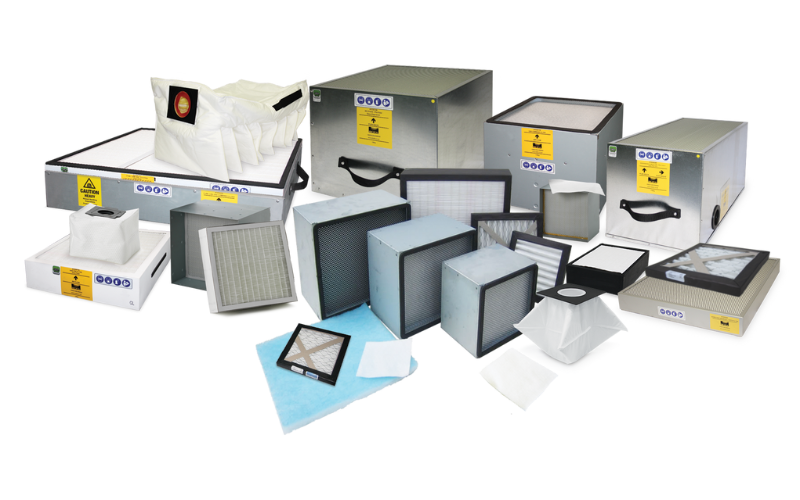
Another important standard, ISO 29463 concerns very high-efficiency filters, such as HEPA (High Efficiency Particulate Air) and ULPA (Ultra Low Penetration Air) filters. These filters are used in sensitive environments, such as laboratories, clean rooms or certain production lines.
The standard classifies filters according to their filtration efficiency, measured at the size of the most penetrating particles (generally 0.3 micron). It ensures an optimal level of safety against the most dangerous particles.
Certifications to know about
CE and machine markings
In Europe, all industrial equipment, including fume extractors and filtration systems, must meet the requirements of CE marking. This proves that the product complies with European directives on safety, health and the environment.
UL and CSA: North American standards
For companies that export internationally or use machines from the United States or Canada, it is worth knowing about the UL (Underwriters Laboratories) and CSA (Canadian Standards Association) certifications. These labels guarantee that the equipment has been tested to strict electrical and mechanical safety standards.
Which standards apply to the BOFA systems distributed by Airpropre?
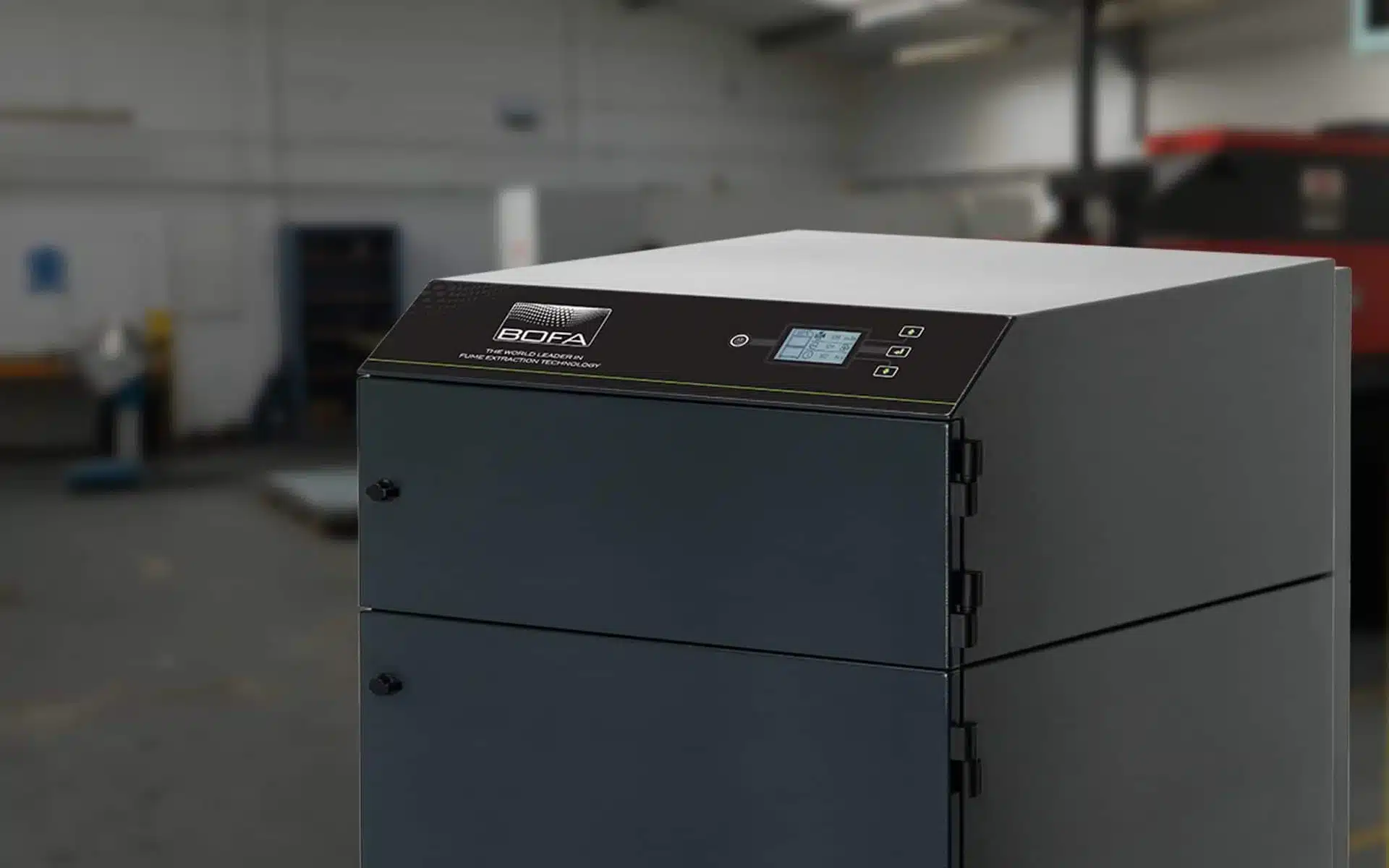
The extractors and filtration systems from BOFA, which we distribute on Airpropre.fr, meet the most demanding standards on the market. For example:
- Class H13 or H14 HEPA filters comply with the ISO 29463 standard.
- The systems are designed to meet the requirements of ISO 16890.
- All products carry the CE marking.
This way, you can be sure of installing a reliable, high-performing system that complies with the regulations.
Why comply with standards?
Choosing an air extractor or a filter that complies with ISO standards is not a mere formality. It is a guarantee of safety, of performance, and also of durability. It also protects you in the event of an inspection, an accident or a dispute. Finally, it is also a way of showcasing your commitment to occupational health and safety.
Conclusion
ISO standards and certifications in industrial air filtration should not be taken lightly. They help you make the right choices to ensure clean air and a working environment that complies with regulations. At Airpropre.fr, we offer certified equipment suited to all sectors of activity. If you have any questions, our team is here to guide you in your choices.