
Ventilation and filtration in laboratories: why it’s essential
In a laboratory, safety does not rely solely on personal protective equipment or good practice. Ventilation and air filtration are also essential elements. Too often overlooked, they nevertheless play a key role in protecting people, samples and the environment. In this article, we explain why air management in laboratories is a priority, and how to equip yourself properly.
Healthy air for a safe laboratory
It is easy to underestimate the risks associated with the air in a laboratory. Yet many substances used every day can release hazardous gases, vapours or particles. Examples include solvents, volatile chemicals and biological agents.
Without an effective filtration or extraction system, these contaminants can build up in the ambient air. This poses a danger to the health of technicians, researchers and other laboratory users. Moreover, some pollutants can interfere with ongoing experiments or damage sensitive equipment.
Good ventilation is therefore not always enough. It is often necessary to add targeted filtration systems capable of effectively treating polluted air.

The dangers of poorly filtered air
Contaminated air can have multiple effects. First, on human health: irritation, allergies, respiratory problems or poisoning may occur. Second, on experimental results: certain particles or vapours can skew measurements, alter samples or trigger unexpected reactions.
In addition, some agents present in the air can be flammable or corrosive. They then increase the risk of accidents. Finally, unfiltered air can spread outside the laboratory and contaminate other areas.
For all these reasons, it is essential to put suitable air treatment solutions in place.
What is the difference between ventilation and filtration?
It is important to distinguish between two key concepts:
- Ventilation consists of renewing the ambient air, often by mechanical or natural means.
- Filtration, for its part, captures and retains particles, fumes, gases or micro-organisms before they spread.
The two are complementary. For example, ventilation dilutes pollutants, while filtration removes them. That is why it is recommended to install combined systems, especially in laboratories where the risks are high.
The most common filtration solutions
Among the equipment most commonly used in laboratories are:
- Filtering hoods: they capture toxic vapours at source.
- Local extraction arms: ideal for occasional workstations.
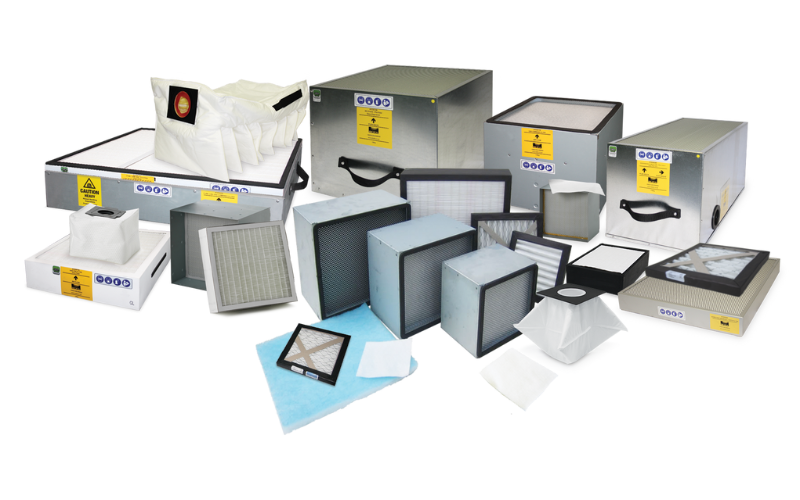
- Extractors with HEPA or activated carbon filters: highly effective for fine particles or volatile organic compounds.
- Ventilated cabinets: for storing chemicals safely.
At Airpropre.fr, we offer a wide range of filtration solutions for laboratories, tailored to the specific needs of each activity: chemistry, biology, electronics, pharmaceuticals and more.
Standards and obligations to comply with
In France and in Europe, laboratories must comply with strict air quality standards. For example:
- The ISO 14644 standard for cleanrooms,
- The French Labour Code, which requires suitable ventilation of workplaces,
- The INRS recommendations on source extraction and air treatment.
Complying with these standards is not only a legal obligation: it is also a guarantee of safety and performance.
The benefits of good filtration
Installing a suitable filtration system offers many benefits:
- Better operator health, with lower exposure risks;
- Enhanced safety, by limiting ignitions or product leaks;
- Improved research quality, with stable and clean conditions;
- Longer equipment service life, by preventing harmful deposits;
- Guaranteed regulatory compliance, in the event of an audit or inspection.
Moreover, good filtration is an asset for your laboratory’s image, particularly if you host partners or are engaged in a CSR (corporate social responsibility) approach.
Conclusion
Ventilating and filtering the air in a laboratory is not an option: it is a necessity. The risks associated with contaminated air are very real, but solutions exist. By combining ventilation, suitable filtration and compliance with standards, you create a safe, healthy and high-performing environment.
At Airpropre.fr, we help you choose and install the most effective filtration systems for your activity. Please feel free to contact us for a personalised study.