
HEPA filter: role, operation and efficiency
HEPA (High Efficiency Particulate Air) filters are essential components in many air filtration systems. They can be used in both domestic and industrial environments. Their ability to trap fine particles and allergens makes them key solutions for improving air quality. In this article, we will explore the role, operation and efficiency of HEPA filters.
What is the role of the HEPA filter?
The fundamental role of a HEPA filter is to capture and filter airborne particles, in particular fine particles, allergens, bacteria and viruses. It is a key technology in air purification, as it helps to remove harmful contaminants and provide cleaner, healthier air in an indoor environment, whether in a home, a hospital, a laboratory or an industrial facility. HEPA filters are designed to maintain air quality by reducing pollution and health risks and by protecting equipment.
How does a HEPA filter work?
HEPA filters are sophisticated components designed to filter and remove fine particles and airborne contaminants. Their efficiency relies on mechanical and electrostatic filtration technology, ensuring high-quality air purification.
Composition of HEPA filters
These filters are made from pleated synthetic fibres. The purpose of this pleating is to create very narrow passages for the air through the filter medium. These passages, resembling a very fine mesh, are essential for effectively capturing airborne particles.
Particle separation process
When air passes through the fibres of the HEPA filter, several filtration mechanisms come into play. First of all, particles larger than the openings in the filter are trapped mechanically. This happens through the principles of interception and impaction, whereby moving particles are captured by the fibres themselves. However, HEPA filters go beyond simple mechanical filtration. Particles smaller than the openings in the filter are also captured through diffusion and electrostatic force. The filter’s fibres are electrically charged, which attracts charged particles towards them. These small particles are thus captured and filtered effectively.
Special filtration materials
HEPA filters are filtration products made from special materials. They guarantee high efficiency. The synthetic fibres are arranged to maximise the capture and interception of particles, while allowing sufficient airflow to ensure adequate ventilation. This means that, despite their ability to trap very small particles, they do not significantly restrict airflow. These products are designed to be durable and require little maintenance. However, it is essential to follow the pre-filtration procedures, and the requirements for sealing, replacement frequency and maintenance, in order to preserve their optimal performance over the long term.
How can you recognise a HEPA filter?
Recognising a HEPA filter is essential to make sure it is effective. Genuine HEPA filters are subject to strict quality standards, and their performance is certified. When trying to identify a HEPA filter, look for information such as the filtration class (for example, H13 or H14) and certification by recognised bodies. In addition, HEPA filters are generally associated with highly reputed brands, such as BOFA International – Groupe Donaldson, which is renowned for its high-quality air filtration products.
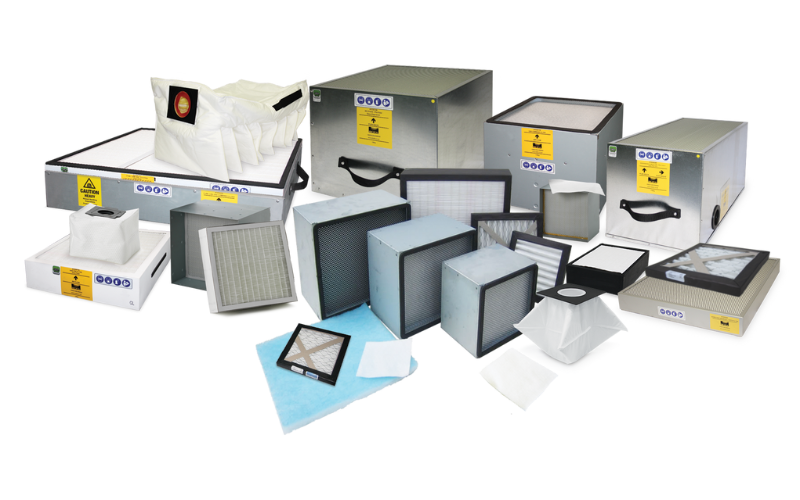
Filter classification: H13 and H14 filters
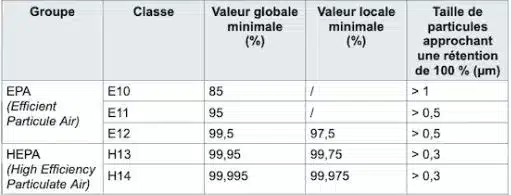
HEPA filters are often classified according to their filtration efficiency. Class H13 and H14 filters are among the most efficient. Class H13 HEPA filters are designed to trap at least 99.95% of particles of 0.3 microns and above, while class H14 HEPA filters have an efficiency of at least 99.995% for particles of 0.3 microns and above. These very high-quality filters are commonly used in environments where indoor air ventilation is crucial, such as pharmaceutical cleanrooms, research laboratories and operating theatres.
HEPA filters differ significantly in their composition. There is a standard, the European Standard EN 1822-1, which classifies them according to their performance and efficiency. This standard divides filters into three categories:
It is also essential to note that HEPA filters must pass a test in order to be classed as HEPA. The purpose of the test is to measure the flow and the percentage of particles captured within the filtration device, in order to determine filtration efficiency and the size of the fine particles. As a result of this test, HEPA filters are classified into five distinct categories, according to their performance, their use and, of course, their efficiency. These HEPA filters are essential in the fight against air pollution and offer relevant solutions for protecting your staff’s health.
In conclusion, HEPA filters play an essential role in improving air quality by effectively trapping fine particles and contaminants. Their mechanical operation and their classification guarantee high-performance air filtration.