
3D printing fumes: why is extraction needed?
3D printing, also known as additive manufacturing, is a revolutionary technology that has transformed the way we design and produce objects. Thanks to 3D printing, it is now possible to create custom parts at a relatively low production cost. However, this innovation is not without risk, as 3D printers emit fumes and gases that are potentially hazardous to health and the environment. In this article, we will explore the growth of the 3D printing sector and the risks associated with fumes from filaments such as PLA and ABS, as well as the air extraction solutions designed specifically to filter 3D printing fumes.
3D printing: a growing sector
3D printing offers many advantages, including the ability to produce custom parts with great precision and a relatively low production cost. This technology is increasingly used in various industrial sectors, from medicine and the automotive industry to aerospace. Product customisation and waste reduction make 3D printing a promising manufacturing method for the future.
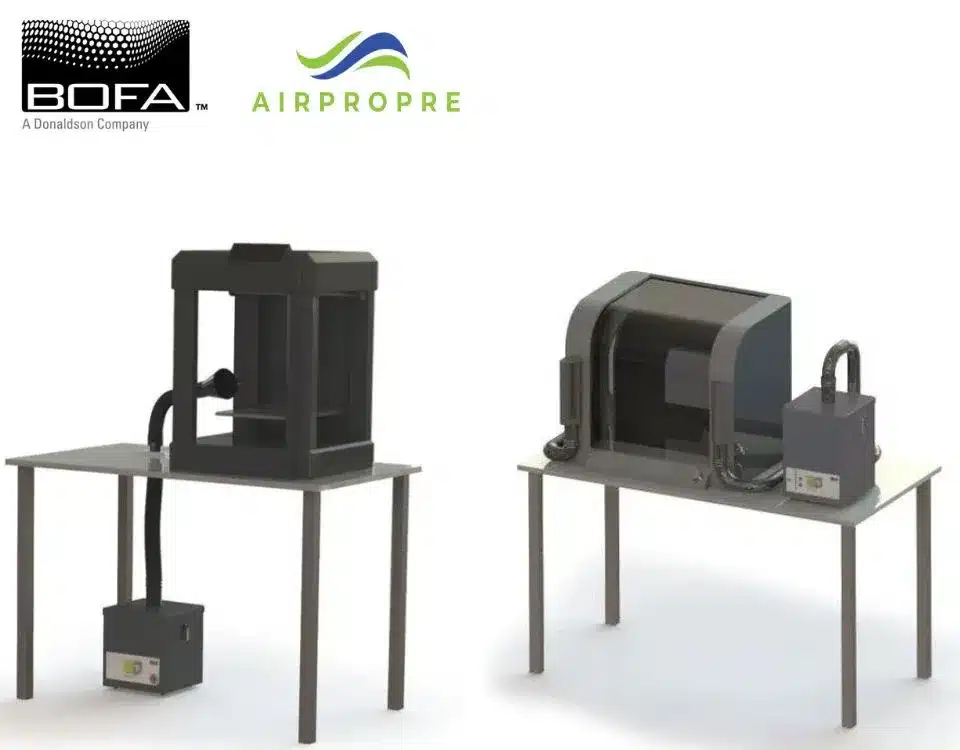
3D printing fume extraction: emissions of hazardous particles and gases
Depending on the material and printing process used, the pollutants emitted may be flammable, while also posing potential health risks if inhaled. This situation becomes particularly critical in large-scale manufacturing, where several machines are running. In this context, it becomes imperative to put in place appropriate ventilation to guarantee a safe working environment.
PLA filament fumes
PLA (polylactic acid) is one of the most commonly used filaments in 3D printing. It is valued for its ease of use and its biodegradability. However, when PLA is heated and melted for printing, it gives off fumes that can contain fine particles and volatile organic compounds (VOCs). These emissions can pose risks to health and safety, particularly if printing takes place in a poorly ventilated space.
ABS filament fumes
ABS (acrylonitrile butadiene styrene) is another material commonly used in 3D printing. It is valued for its strength and durability. However, when heated for printing, it also gives off fumes containing fine particles and VOCs. These emissions can cause respiratory problems and other health effects.
3D printing fume extraction: the risks of poor air filtration
When the particles emitted by 3D printing are not properly filtered, they can cause indoor air quality problems. Ultrafine particles, present in fumes and gases, can remain suspended in the air and be inhaled by the room’s occupants. In addition, some toxic gas emissions can compromise the safety and health of those exposed. It is essential to put adequate filtration in place to reduce these risks.
Air extraction solutions for office applications and large-scale manufacturing
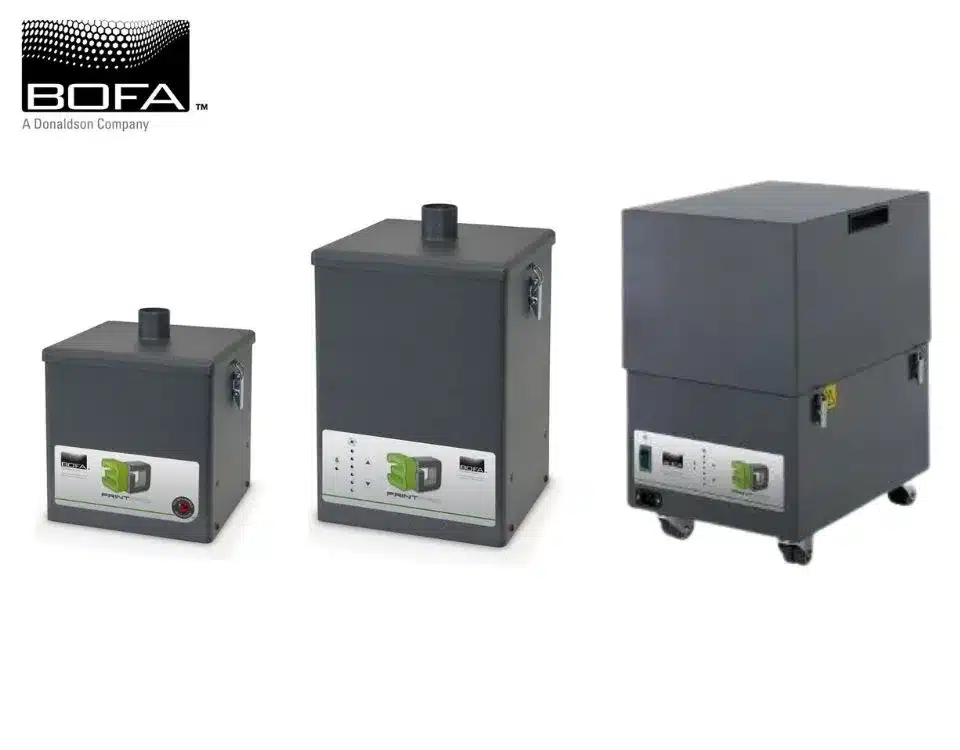
To combat the pollution associated with 3D printing, it is essential to have effective air extraction systems. The BOFA – Donaldson fume extractors offer solutions specially designed for 3D printing applications. Two ranges stand out: the PrintPro and 3D PrintPro ranges. These extraction systems are equipped with HEPA and activated carbon filtration technology, designed to capture the micro-particles and potentially toxic odours generated by printers.
The PrintPro and 3D PrintPro ranges offer a variety of extractor sizes and power ratings to suit environments ranging from offices to large-scale manufacturing facilities. These extractors ensure better indoor air quality, thereby reducing risks to health and the environment.
In conclusion, extracting and filtering 3D printing fumes is essential to guarantee the safety and health of exposed people. BOFA fume extractors, with their high-quality filtration systems, offer solutions suited to the needs of 3D printing, thus contributing to a safer, healthier working environment.