What is the best fume extractor for laser machines?
Laser processing changes the nature of the materials it works on. Laser engraving melts plastic or wood, for example, while laser marking and cutting dissolve them. The result? In every case, the release of countless fine particles and a large amount of fumes, which are hazardous to people with prolonged exposure. The solution? Stop the fumes from reaching your staff’s respiratory tract by means of powerful suction and extraction. But how do you choose the best fume extractor for a laser machine ? Here is a complete guide to help you.
The laser extractor: a tool for your safety
Before going into product details, it is worth stressing the significant risks caused by the dust and fume emissions generated by laser work. These can be highly toxic and, if inhaled, cause serious health problems for operators: lung damage, cardiovascular disorders, skin diseases, and so on. Your employees’ health is too important to let even a few harmful particles reach them. That is why it is important to choose the best fume extractor for your laser applications.
Complying with environmental standards: a challenge to be met
Fumes can also have a harmful effect on the environment. The molecules produced by the breakdown of the materials being processed add to air pollution and can even harm wildlife and plants. It is therefore mandatory not only to extract the fumes to ensure a healthy indoor environment for your employees, but also to filter them so that they do not endanger the ecosystem.
Moreover, in processing the materials being worked, the laser may start fires. It is therefore your responsibility to ensure that effective extraction eliminates this risk.
The features of the fume extractor
For all these reasons, using a fume extractor is a prerequisite for operating laser machines in a factory. Whatever your activity, the power of your machines or the materials you work with, the principle of an extractor remains the same, and it is quite simple.
Every fume and dust extraction system combines two elements:
There are three methods of capturing fumes at the point of extraction: a flexible arm or a nozzle positioned at the marking or engraving point, an enclosure surrounding the marking area, or, more broadly, extraction from within the laser cabinet.
The different levels of filtration
The filter is an essential component in a laser extractor. Without it, all the dust, including the most toxic, would end up in the atmosphere and actively contribute to environmental pollution.
There are three types of filter, whose properties we will describe in detail.
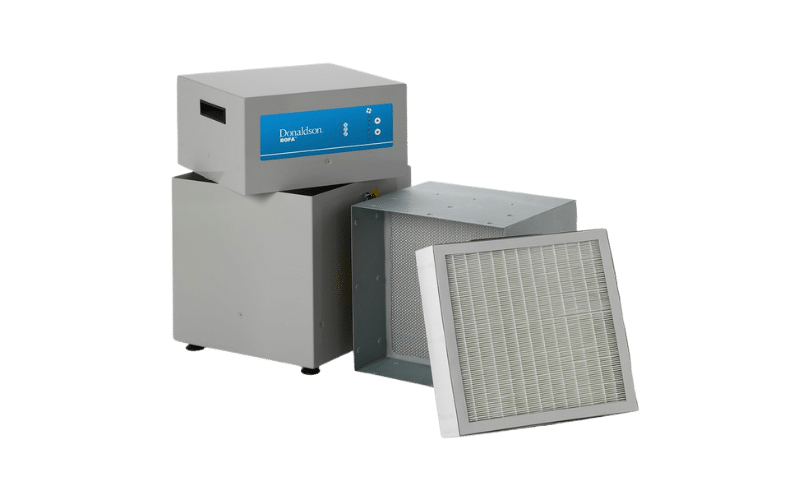
The pre-filter
This is the first filter, found on all extractors. Made up of a pleated surface, most often in synthetic fibre, it is there to trap large particles of more than 5 microns.
The HEPA filter
Next, the HEPA filter, short for High Efficiency Particulate Air filter, is made up of a layer of fibres that removes 99.97% of particles of 0.3 micron, in other words all fine dust. Once the pre-filter has done its job, they thus make it possible to remove all (or almost all) traces of particle pollution.
The activated carbon filter
Finally, the activated carbon filter completes the trio where necessary. Thanks to its porosity, activated carbon removes odours and traps gases and volatile organic compounds (VOCs), which can also be harmful. In some cases, manufacturers offer carbon filters combined with a chemical filter, for example one using potassium permanganate, which captures the VOCs that escape the carbon.
The larger your laser machine, the larger the filtration surface needs to be. It is important to be aware of these characteristics and take them into account when choosing the best fume extractor for your application.
Filter service life
A filter must be replaced regularly. Since a filter's purpose is to retain vaporised dust, there comes a point when it will become saturated.
It is difficult to give a service life for each type of filter. It depends entirely on how the extractor is used: type of laser activity, hours of use, type of machine and so on.
However, a filter needs changing after a few months. The extractor has a gauge or indicator that alerts you. First change the pre-filter, then the HEPA filter and the carbon filter.
Extractors for laser engraving and marking
Laser marking and coding produce very fine dust and gases or volatile organic compounds, depending on the material being worked. Engraving, which is deeper, works in the same way, but the residues released are far more abundant. Depending on your activity, you can therefore opt for more or less powerful extractors.
Some models have a maximum extraction power of 200 cubic metres per hour, which is sufficient for low to medium-intensity marking work. For more demanding jobs, and for engraving, higher airflows are preferable. Many models are available with extraction rates of 800, 1,000 or even 1,500 cubic metres per hour. The larger your machine, the greater the volume of air that needs to be moved. The air speed is adjustable.
The last factor related to the unit’s capacity is its electrical power. Small extractors are rated at less than 1 kWh, whereas machines for large volumes of fumes exceed 3 kWh.
The airflow is adjustable by the user. Each system includes at least a pre-filter and a filtration element, HEPA or activated carbon in most cases (see below). For small or medium volumes of fume, this is often enough. For larger emissions, manufacturers offer two types of filter.
The weight of the units varies greatly according to their capacity. For a small-capacity extractor (200 cubic metres), it starts at 25 kg, but many machines go well beyond 100 kg. Finally, it should be noted that most of these units, while noisy, typically have noise emissions of between 58 and 68 dB.

Extractors for laser cutting
Laser cutting can be carried out using three possible techniques:
As these techniques produce gas and dust, some of it often smaller than a micron, they require very low filtration velocities.
In the face of these challenges, you will need extractors of the same design as those suited to laser marking and engraving work, but more powerful. Depending on the volume and quality of the materials being worked, you will need at the very least an extractor rated above 1000 m3/h.
As the particles are very fine, a system combining two filters in addition to the pre-filter will also be required.
The ideal extraction for every level of filtration
High extraction power is not necessarily required to achieve optimal extraction. Once again, it all depends on several factors: the activity (between coding and cutting, we have seen that the needs are very different), the size of the laser machine, the material being worked, which does not release the same type of dust, and the volume and workspace itself.
The right combination must therefore be found according to these different criteria. To help you choose the best fume extractor, it is important to base your decision on all of these criteria. Nevertheless, some products are of a quality that guarantees optimal and durable operation.
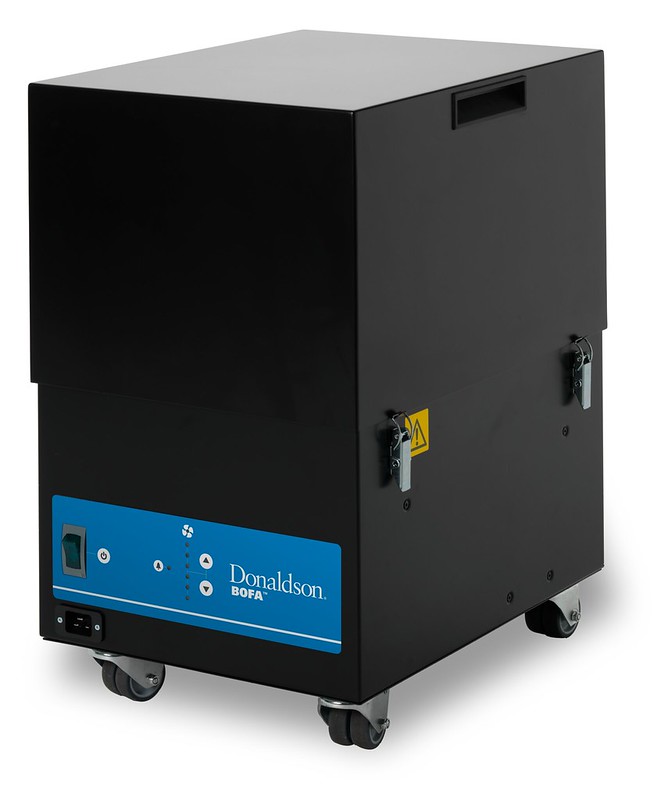
BOFA laser fume extractors
BOFA laser fume extractors are a benchmark in the field. The brand has been developing its expertise since 1987 and has become the world leader in this area.
The strength of its units lies in the perfect balance between high airflows and pressures on the one hand and filtering capacity on the other. All are equipped with a reverse airflow system, which reduces air speed and reverses the direction of the air.
The BOFA extractor range is wide. It starts with the AD-ACCESS, a compact unit designed for light-duty laser marking, coding and engraving. Economical and high-performing, it already uses three filters, one of which is chemical-based, for perfect filtration.
Three of the units in the range are fitted with the IQ system, such as the AD-1000-IQ, which brings the most advanced technology to bear in an intelligent extractor. The excellence of this equipment means minimal maintenance and reduced downtime. Units in the BOFA range are recognised by market players as the products that come closest to the ideal of the best fume extractor.